
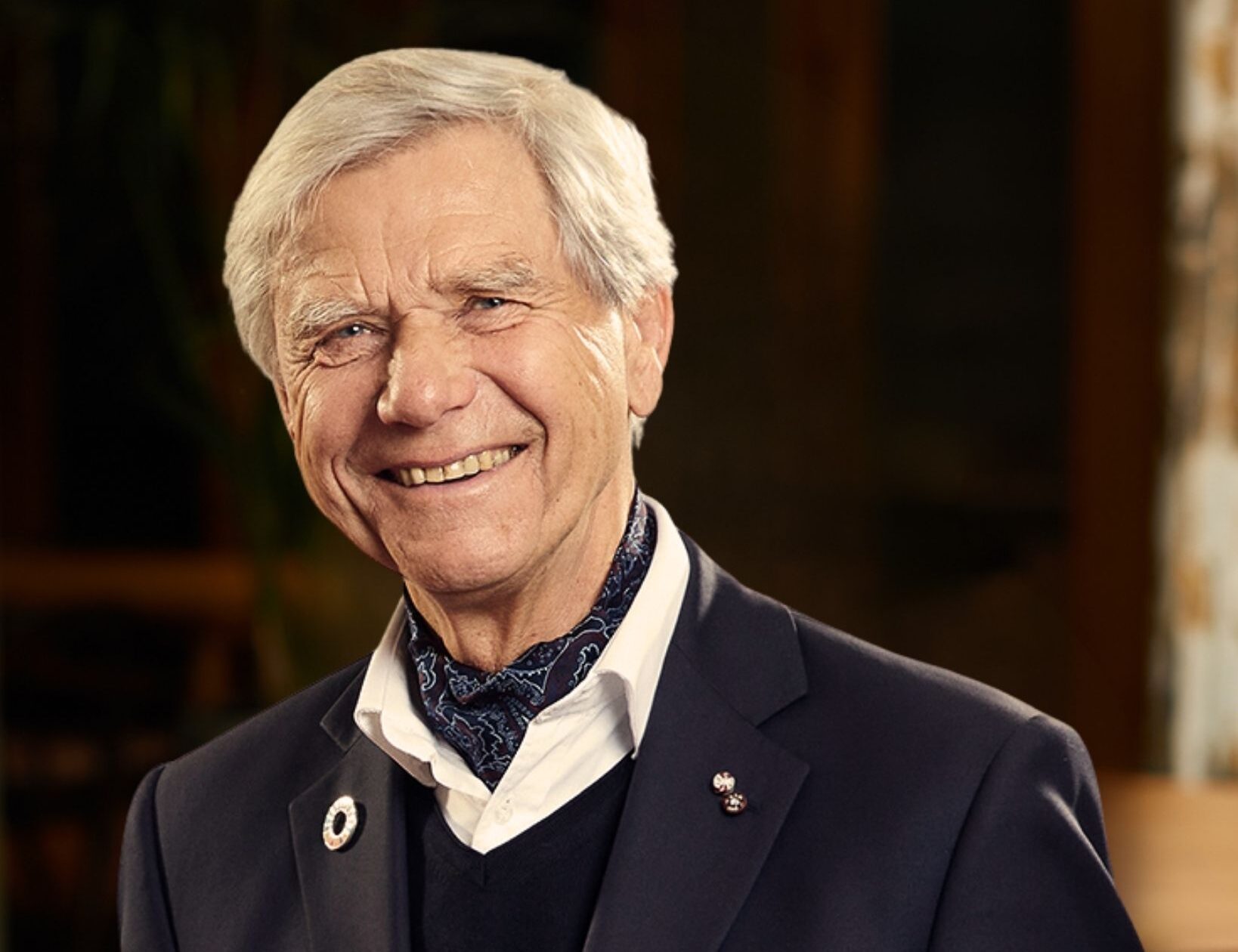
Hermann Hauser doesn’t just build companies—he builds the ecosystems that make them thrive.
While most entrepreneurs focus on scaling a single venture, Hauser’s career reveals a rarer, more transformative skill: the ability to connect people, institutions, and ideas in ways that turn regions into enduring innovation powerhouses.
From co-founding Acorn Computers in a Cambridge lab to shaping Europe’s deep tech landscape today, his story isn’t just about entrepreneurial success—it’s about how to create the conditions for success to spread, again and again.
Born in 1948 in Vienna and raised in a Tyrolean village where his father ran a wine business, Hauser’s journey began far from the corridors of Silicon Valley. Yet his curiosity, sparked by an uncle who taught him about quantum mechanics on mountain walks, and his knack for bridging gaps between academia and industry continue to redefine what a tech ecosystem can achieve.

At Cambridge, he didn’t just launch a company; he helped rewire a culture, convincing sceptical professors that commercialising research wasn’t selling out—it was scaling impact.
The result? A living legacy that includes ARM, one of Europe’s most valuable tech firms powering over 99% of all smartphones, a network of over 100 Cambridge startups spawned from Acorn’s alumni alone, co-founding a tech ecosystem worth over $220 billion and an ongoing mission to prove that collaboration, not just capital, fuels revolutions.
He is also one of the only people ever to have a million x return on their initial investment, turning an initial £100 starting investment in Acorn into £100 million in just five years.
And his work would eventually help save Apple from bankruptcy.
So, what is Hauser’s entrepreneurial playbook?
His approach wasn’t formed in business school or learned from investors, it was forged through decades of pushing against convention.
Challenge the Status Quo – founders must be prepared to educate investors and stakeholders about the unique dynamics of their startups.
Hauser’s father instilled in him a sense of responsibility and resilience from a young age. He learnt from his father’s wine business that entrepreneurship wasn’t just about profit, it’s also about solving problems and supporting people.
When he was at Cambridge in the 1970s, the university professors resisted the commercialisation of all the research taking place. The attitude was very much “What do you mean we want to do deals with Mammon? This is not what we do.”
However, Hauser’s persistence helped shift that culture, proving that challenging norms is essential for progress, resulting in the Cambridge ecosystem becoming one of the world’s leading centres of innovation and investment opportunities.

Founders should embrace their roots and be prepared to advocate for their vision, even in the face of deep scepticism.
But challenging norms was only the first step. Hauser understood that individual breakthroughs, no matter how revolutionary, need fertile ground to flourish.
Build Ecosystems, Not Just Companies – innovation is a “team sport” requiring collaboration between universities, government, and finance.
The value of informal networks and collaborations in such ecosystems is also not to be underestimated.
In 1997, Hauser also co-founded the Cambridge Network to bridge academia and business, creating a platform for serendipity and collaboration.
Whilst most entrepreneurs build companies, Hauser has built ecosystems that outlive individual ventures. His legacy won’t just be Acorn or ARM, it’s the hundreds of startups, thousands of jobs and the cultural shift that has made Cambridge a tech powerhouse.
This ability to catalyse collective success sets him apart.
Hauser’s deep ties to Cambridge—from his first visit as a teenager to co-founding Acorn—show how ecosystems drive innovation. His work with the Cambridge Network and Acorn’s alumni proves that collaboration scales impact far beyond individual companies.
Founders should prioritise building networks, not just products.
Of course, building ecosystems requires resources. Yet Hauser’s early approach to funding was anything but conventional; it was born of necessity and ingenuity.
Embrace Financial Creativity – early-stage startups often require creative funding strategies.
Hauser and Chris Curry started Acorn with just £100, £50 each. “The total amount of money that we put into Acorn Computers was £100. But when we went public, every pound was worth £1 million.”

For Acorn, traditional retail distribution was out of reach, so Hauser took inspiration from Clive Sinclair, an entrepreneurial pioneer in the computing industry who launched the UK’s first mass-market home computers such as the ZX80 and ZX Spectrum, and adopted his mail-order model to sell Acorn’s computer kits directly to enthusiasts.
This meant there was no need for physical stores or a large inventory, and the pre-sales funded production thereby reducing financial risk. The strategy validated Acorn’s product before scaling as it showed that there was real demand for affordable, DIY computers, a critical proof point for investors and partners.
Hauser’s use of mail-order sales underscores his ability to turn limitations into advantages and proves entrepreneurs don’t need vast resources to start; they need ingenuity and adaptability.
Founders should explore alternative funding models (grants, pre-sales, bootstrapping) and focus on scalable, low-cost strategies to validate their ideas.
Creative funding bought Acorn time, but timing itself proved to be another crucial ingredient in Hauser’s formula, one that often defied conventional wisdom.
Time Your Market Entry – economic downturns can be strategic opportunities for startups.
In Hauser’s experience, the best time to start a company is during a downturn. Founders will have access to more talent and the venture capital community is more patient.
When Acorn faced collapse in 1984, its acquisition by Olivetti wasn’t an end, it provided a lifeline and a lesson in adaptability.
For Hauser, it was a pivot, from Founder to Executive.
He became VP of Research, gaining first hand experience in corporate strategy, scaling and global operations. He learnt from a master at the time, Olivetti’s chairman Carlo de Benedetti, who also taught him how to manage large-scale innovation and how to attract top talent.
This experience became the foundation for his later work as a venture capitalist, proving that even setbacks can be stepping stones.
Founders should seize opportunities in adversity, whether it’s hiring talent, negotiating partnerships, or pivoting their business model.
Hauser’s legendary resilience is a hallmark of his career, and it stems from a fundamental understanding that true transformation doesn’t happen overnight.
Prepare for the Long Game – building transformative companies requires patience and resilience.
Hauser’s work with Acorn didn’t end with its sale. The company’s alumni went on to found over 100 startups in Cambridge, creating a lasting impact. Acorn played a similar role in Cambridge that Fairchild played in Silicon Valley.
Hauser’s later ventures through Amadeus Capital Partners, like CSR (fabless semiconductors) and Solexa (genomics), required decades of R&D. For Hauser, innovative companies in ICT and life sciences will drive the next decade of growth.
Hauser’s patience paid off in unexpected ways.
When Apple faced bankruptcy in the 1990s, its $1.5 million investment in ARM, a spinout from Acorn, became a financial lifeline. Selling that stake for $800 million gave Apple the runway to survive until Steve Jobs’ return. As former CEO John Sculley noted, ‘Apple would not have survived’ without it.
Founders should focus on long-term impact, not just short-term gains. They should build companies that solve fundamental problems and create lasting value.
But patience alone isn’t enough; it must be directed toward challenges that truly matter.
Solve Real Problems – target meaningful challenges in technology, healthcare, or sustainability.
For Hermann Hauser, solving real problems isn’t just a business strategy, it’s a philosophy that defines his approach to entrepreneurship and innovation.
As he says, “We’re not going to get growth by producing Nike shoes. It has to come from innovative breakthroughs.”
This reflects his belief that true innovation addresses fundamental needs rather than chasing trends, solving hard problems that create lasting value and not just quick profits.
Hauser’s focus on deep tech isn’t accidental. He believes Europe’s future lies in tackling problems that matter and that this can drive economic growth and sovereignty.
For founders, the lesson is clear: Build for impact, not just exits.

An Interconnected Philosophy
These six principles – from challenging conventions to solving real problems – form an interconnected philosophy. But at their core, they all point to the same fundamental truth.
Hauser’s journey is a reminder that entrepreneurship isn’t just about ideas or capital—it’s about people, networks, and persistence.
As he puts it: ‘Money makes the world go round, but it’s the people, the ideas, and the partnerships that truly drive innovation.’
In an era defined by rapid technological advancements and global challenges, Hermann Hauser’s principles are more relevant than ever.
In a world where collaboration and innovation are key to solving complex problems, his approach offers a blueprint for building not just successful companies but thriving ecosystems.
The question for today’s founders isn’t just ‘what will you build?’ but ‘how will you build the ecosystem around it?’
By embracing collaboration, challenging conventions, and focusing on long-term impact, the next generation of entrepreneurs can create lasting change and drive the innovations that will shape our future.
Sources:
Secret Leaders Podcast: The Man Who Saved Apple From Bankruptcy https://www.youtube.com/watch?v=E4DqDTFjYDw
CYBERUK ONLINE: https://www.youtube.com/watch?v=GcZcp5QYVWE
Professor Alan Macfarlane, Emeritus Professor of Anthropology at King’s College, Cambridge: https://www.youtube.com/watch?v=Xt2weGJbzDI


