
In an age when founders worship at the altar of Silicon Valley, it’s easy to forget that one of the most radical tech revolutions of the last century didn’t begin in California at all. It started in a cramped room in Cambridge, England, where a bespectacled inventor with a soldering iron—and a budget held together with string—was quietly plotting to drag the future forward.
Sir Clive Sinclair didn’t look like a disruptor. He didn’t talk like one. Yet this eccentric British tinkerer built the machines that turned millions of children into coders, launched the careers that shaped Europe’s tech ecosystem, and tried – decades before Elon Musk – to reinvent how cities move. His legacy isn’t a trillion-dollar company. It’s something stranger, more unpredictable, and far more instructive. Sinclair’s story is what happens when raw vision collides with imperfect timing, stubborn brilliance, and a world not quite ready for the future he saw.
And it’s precisely for that reason that his journey remains essential reading for founders today.
The First Revolution: how a tiny computer sparked a generation
One engineer who worked with Sinclair in the late 1970s liked to say that you could measure Sinclair’s obsessions by how many hours he spent arguing over fractions of pennies on component costs. Sinclair believed that affordability wasn’t a constraint, it was the purpose. His mission was to take expensive, complicated technology and shrink it until almost anyone could own it.
That philosophy crystallised in 1980 with the release of the ZX80, a small, startlingly inexpensive personal computer that arrived when its competitors cost several times as much. You could even buy it by mail as a kit and assemble it yourself. It was light, fragile, monochrome, and utterly revolutionary.

The ZX81 followed, then the ZX Spectrum, and soon millions of British living rooms glowed with crude graphics and BASIC code. Children typed in programmes from magazines, teenagers wrote games in their bedrooms, and an entire generation learned to tinker. Some of those bedroom coders grew up to form studios and startups that turned the UK into a global gaming powerhouse.
While America had Steve Jobs and the Apple II, Britain had Sinclair and the Spectrum. The cultural effect was similar: a wave of creators who suddenly realised they could shape technology themselves. In that way, Sinclair’s real genius was not the hardware he shipped but the access he unlocked.
He understood, even if he never used the term, that democratising technology can be the most powerful market strategy of all. Lowering barriers doesn’t just widen an audience; it creates entirely new ones.
The leap into the future that arrived too early
But the thrill of success couldn’t hold Sinclair’s imagination for long. Even as his computers gained momentum, his mind drifted toward a problem most of the world wasn’t thinking about yet: how cities would handle the coming crush of congestion, pollution, and energy inefficiency.
He became convinced that the future of transportation would be small, lightweight, electric, and personal. In other words, he predicted half of today’s urban mobility market in a single instinct.

The problem was that he predicted it about twenty-five years too early.
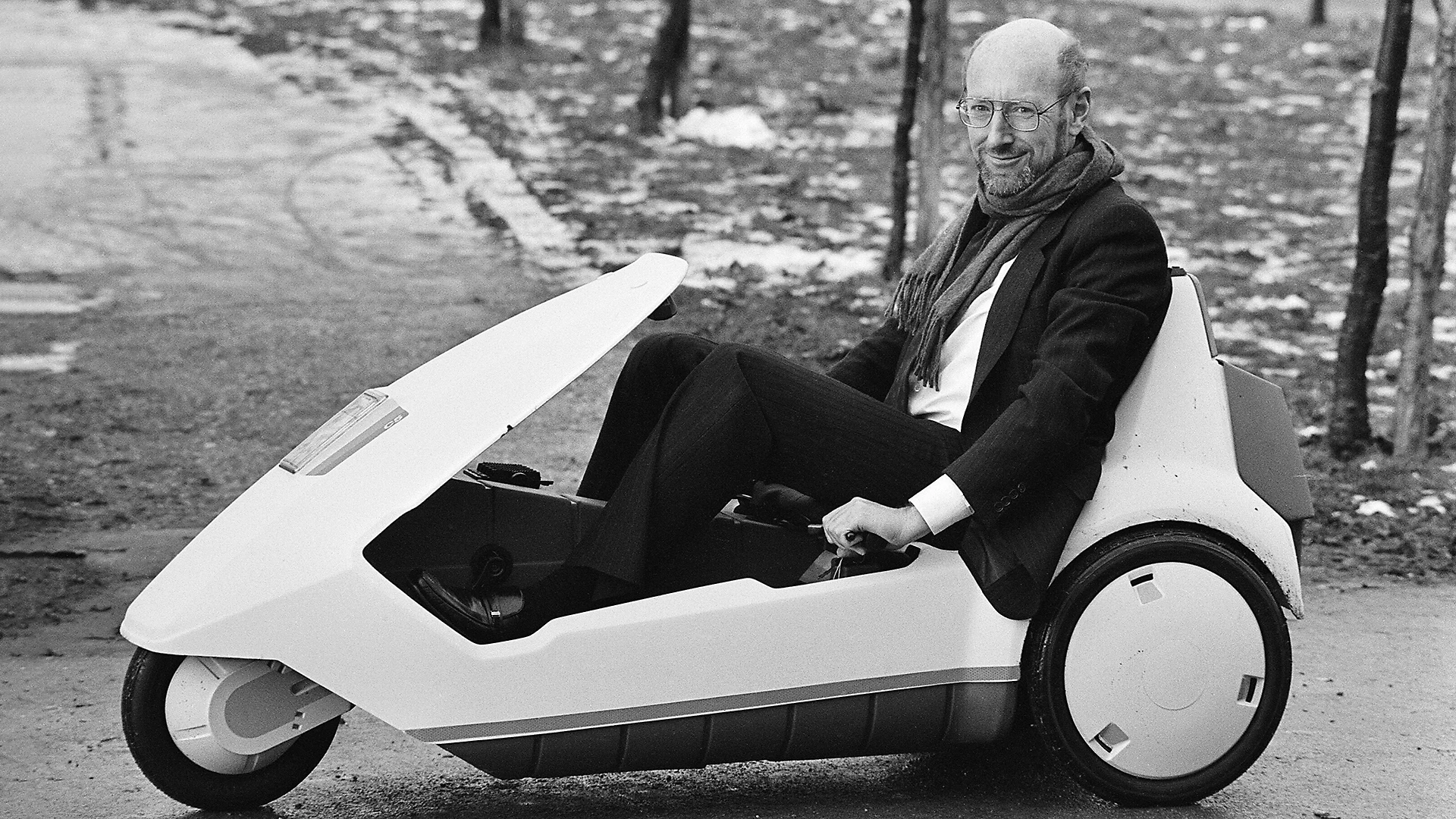
Ignoring warnings from investors and pleas from his engineers to slow down, Sinclair charged ahead with the Sinclair C5, a one-person electric trike that looked like a cross between a pedal car and a science fair project. He launched it with fanfare worthy of a moonshot, even taking journalists on winter test drives to showcase its potential.
It did not go well. The C5 was ridiculed as unsafe, impractical, and embarrassingly odd. Sales sputtered. Media backlash mounted. What Sinclair hoped would be the future of clean, efficient transportation instead became one of Britain’s most famous commercial flops.
Strategically, it is one of the clearest reminders in tech history that vision without market readiness is indistinguishable from failure. The world now embraces ideas Sinclair championed – electric scooters, e-bikes, compact EVs – but in 1985, the infrastructure wasn’t there, the culture wasn’t there, and the economics weren’t there.
Being early isn’t always a badge of honour. Sometimes it’s the very thing that breaks you.
The allure and danger of elegant engineering
If Sinclair had a mantra, it was “Can it be simpler?” He asked it of every design, every circuit, every interface. To him, simplicity was not merely aesthetic, it was ethical. Elegant engineering, in his view, made technology more reachable, more humane, and more widely owned.
This obsession created machines that were astonishingly affordable. But it also created products that sometimes felt fragile, limited, or outpaced by rapidly rising expectations. Sinclair’s computers were marvels of minimalism; they were also notorious for their wobbly keyboards and overheating power supplies.
This was the paradox at the centre of his genius: the same purity of engineering that enabled breakthroughs also blinded him to user frustrations and long-term durability. He trusted his instincts more than the signals of the market.
Founders today may recognise the tension. It is one that has shaped countless startups: the push and pull between engineering perfection and customer pragmatism, between building what you think the world should want and listening to what the world actually does want.
Sinclair lived largely on one side of that line.
The lone inventor and the missing counterweight
After the C5 collapse, Sinclair didn’t disappear. He returned to what he loved most: inventing. He tinkered with pocket televisions, miniature radios, early lightweight computing concepts, dozens of futuristic experiments that kept him at the engineering bench long after he had lost his mainstream influence.

And yet he never built another commercial success on the scale of his early computers. The reason wasn’t lack of creativity. It was lack of partnership.
“If I couldn’t trust myself, how could I trust other people?”
Sinclair distrusted committees, resisted hierarchy, and disliked collaboration. He was happiest working alone or with very small teams. That mindset allowed him to move fast and keep costs low, but it also meant he never had the operational counterbalance that so many other great founders rely on. Steve Jobs had Tim Cook. Bill Gates had Paul Allen and later Ballmer. Akio Morita at Sony had teams of operational architects. Even Elon Musk surrounds himself with deep engineering and manufacturing leadership.
Sinclair had brilliance, but he had no ballast. In the long run, even visionary entrepreneurs need anchors.
The legacy he built, even when the market didn’t notice
Despite the uneven trajectory, Sinclair’s fingerprints are everywhere in modern technology. The democratising spirit of the ZX Spectrum lives on in Raspberry Pi, Arduino boards, and the global maker movement. The bedroom coder culture he created helped establish one of the world’s leading gaming industries. His intuitive leap toward lightweight electric mobility, once mocked, now shapes urban transport policy worldwide.
Sinclair’s story also resonates with entrepreneurs from Tokyo to Shenzhen to Bangalore. He embodies the same drive as Akio Morita, both championed small, elegant consumer electronics that changed culture and both men believed technology should feel personal and joyful; the same ethos as Lei Jun, founder of Xiaomi, by pursuing aggressive pricing and mass-market accessibility, turning affordability into a competitive weapon; the same rebellious instinct as Soichiro Honda, who refused to accept conventional design wisdom and challenged incumbents with unconventional engineering and believed small devices could reshape entire industries; and even the same bittersweet mix of brilliance and commercial struggle seen in Nikola Tesla, both leaving a legacy defined as much by possibility as by profit
His life reminds founders that innovation is not a straight line. It is a mix of triumph, miscalculation, and relentless imagination.
The founder lessons still standing
When entrepreneurs look at Sinclair’s career, they encounter a reflection rather than a prescription. They see the power of lowering barriers so drastically that whole industries form in the gaps. They see the risks of creating a product the world is not yet prepared to understand. They see the delicate relationship between elegant engineering and messy user reality, and the importance of pairing visionary thinking with grounded operational strength. And they see how creativity often blooms under constraint rather than abundance.
Most of all, they see a man who never stopped believing that technology should be personal, approachable, and shaped by human possibility, not corporate ambition.
The imperfect genius who invented futures
Sir Clive Sinclair never built the next Apple or Google. But he built something just as rare: tools that taught a generation it was capable of building its own future. His ideas were sometimes premature, sometimes flawed, sometimes brilliant, but always driven by an irrepressible desire to make technology smaller, cheaper, and more human.
For founders today, his story is a reminder that innovation’s value isn’t always measured in valuation, market share, or exits. Sometimes it’s measured in the spark you ignite. Sometimes it’s reflected in the people who build upon the foundation you laid. And sometimes it’s simply the courage to imagine a world that hasn’t yet arrived and to start building it anyway, whether or not the market is ready.

Sinclair’s legacy is imperfect, eccentric, and utterly unforgettable. And for entrepreneurs seeking inspiration beyond the usual Silicon Valley canon, his life offers something rare: a vision of innovation unbound by geography, resources, or conventional thinking. A reminder that the future can begin anywhere, even in a small room in Cambridge with a soldering iron and an unreasonable dream.


